

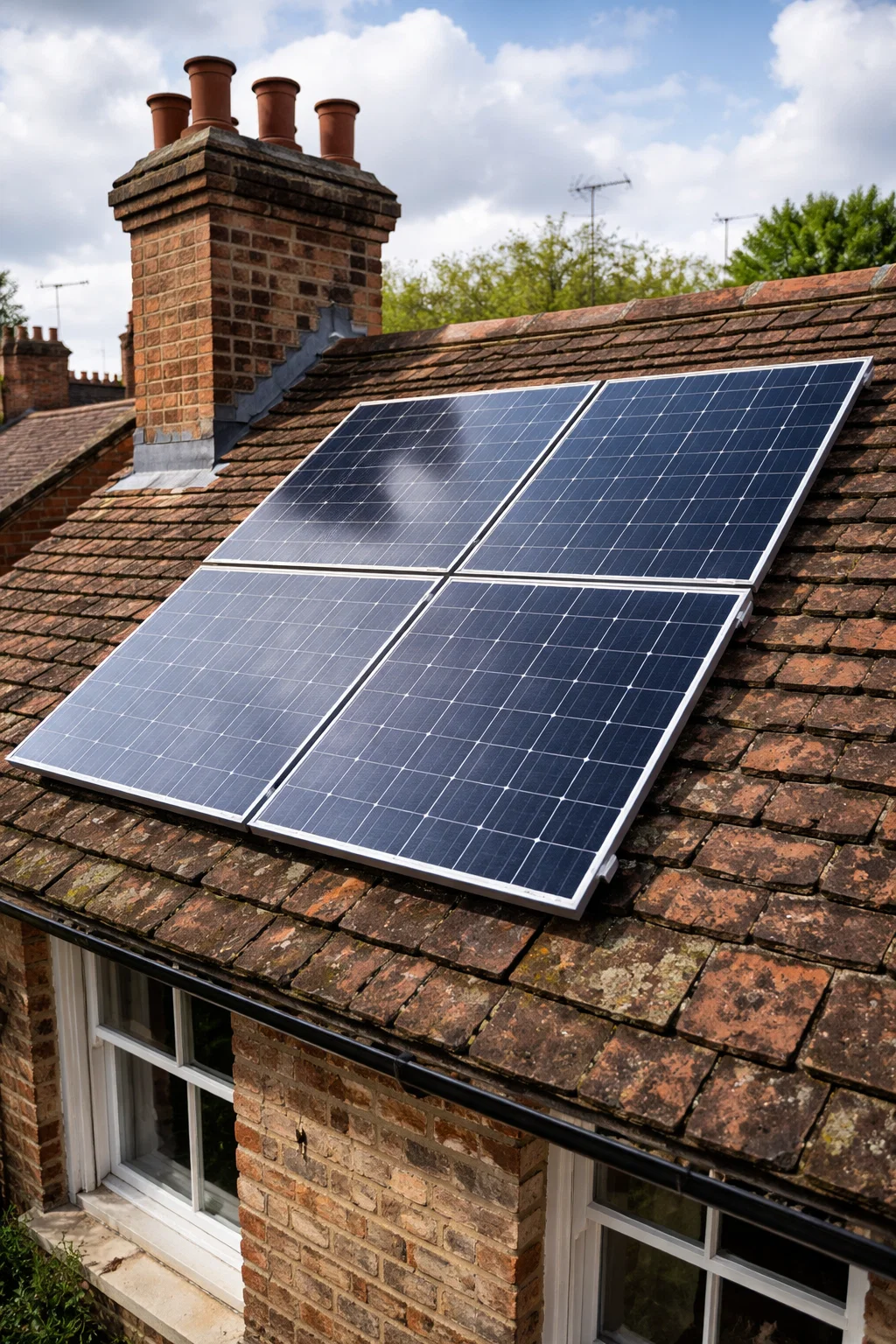
If you spend any time walking through Uppingham, you’ll notice something subtle.
On newer builds near the edge of town, solar panels sit neatly along rooflines. On older properties, they are positioned more discreetly, often to the rear. They are not everywhere. But they are certainly more common than they were five years ago.
The interest is understandable.
Energy bills have become less predictable, and homeowners are looking for ways to steady the ship. Naturally, that leads many to ask whether solar panels Uppingham genuinely make sense, both financially and practically.
The answer depends on more than a headline cost. It depends on the property, the roof, the usage habits and the long-term plans of the household.
Let’s look at it properly.
Why Uppingham homeowners are considering solar
Uppingham is not a uniform housing market.
There are modern estates with ideal south-facing roofs. There are stone cottages with character features. There are detached family homes with larger energy demands.
That variety means the case for solar panels Uppingham changes slightly from house to house. However, there are consistent themes.
Firstly, electricity usage has risen. Home working is more common. Electric vehicles are appearing on driveways. Kitchens and appliances are more energy intensive than they once were.
Secondly, people want greater control. Solar does not remove energy bills entirely, but it can reduce reliance on grid electricity in a noticeable way.
Planning considerations in Uppingham
Before costs are discussed, planning needs to be addressed.
In most situations, domestic solar panels fall under permitted development. That means planning permission is not required provided panels meet standard criteria and are not installed on listed buildings.
However, Uppingham has conservation areas and a number of historic properties. In those cases, additional checks may be necessary.
A local installer familiar with Rutland’s planning approach will usually advise early in the process. That prevents unnecessary delays once installation is scheduled.
How much do solar panels cost in Uppingham?
Costs for solar panels Uppingham are broadly similar to neighbouring towns such as Oakham and Stamford, although roof complexity can affect labour time.
For a standard family home installing a 3.5kW to 4kW system, most homeowners spend between £5,500 and £7,000. This includes panels, inverter, installation, scaffolding and certification.
Larger homes that require 5kW to 6kW systems generally see total costs between £7,500 and £9,500.
Battery storage, which is increasingly popular, adds approximately £3,000 to £5,000 depending on capacity.
While these figures provide guidance, they are refined following a site survey that considers roof orientation, structure and energy usage.
What affects installation pricing?
Several factors consistently influence pricing in Uppingham.
Roof direction
South-facing roofs produce strong output. East and west-facing roofs also work well locally, although system sizing may adjust slightly.
Roof condition
Older properties may require structural checks before installation proceeds.
Access
Limited access or multi-storey properties can increase scaffolding costs.
Electricity consumption
Homes with higher usage often justify larger systems.
Each of these points becomes clear during a professional survey, which should always precede final quotations.
How much can homeowners realistically save?
Savings depend largely on behaviour.
Most Uppingham households installing solar panels reduce annual electricity bills by between £600 and £1,000. Homes that include battery storage can increase savings, particularly where electricity use continues into the evening.
The largest benefit comes from using your own generated power rather than exporting it.
Export payments through the Smart Export Guarantee provide a small additional return, although self-consumption is the primary financial driver.
For many homes, payback falls within six to nine years. Panels typically carry performance warranties of 25 years, meaning savings continue long after initial costs are recovered.
Long-term benefits beyond the bill
Cost savings are often the headline. However, there are other benefits worth considering.
Greater energy stability
Electricity markets fluctuate. Generating your own power cushions that uncertainty.
Lower carbon footprint
Solar reduces reliance on fossil fuel generation.
Appeal to future buyers
Energy efficiency is increasingly important in property decisions.
Solar is rarely installed for a single reason. It tends to form part of a broader long-term outlook.
Should Uppingham homeowners consider battery storage?
Battery storage has become more common locally over the past two years.
For households out during the day, a battery allows surplus energy to be stored and used later. This increases independence and often shortens payback.
EV owners in particular find battery storage appealing because it can offset charging costs.
Further information can be found on the Domestic Battery Storage page for those weighing this option.
Choosing the right installer
Solar installation is not purely about equipment. It is about system design and long-term support.
Working with a regional provider such as Rutland Renewables ensures the installation reflects local housing stock and planning expectations.
You can explore their approach in more detail on the Domestic Solar PV Installation service page.
Local experience often translates into neater installations and clearer communication.
Common questions about solar panels Uppingham
Are solar panels worth it in Uppingham?
For many households, yes. Particularly where electricity use is steady and roof space is suitable.
How long does installation take?
Once scaffolding is in place, most domestic systems are installed within one to two days.
Do solar panels work well in Rutland weather?
Yes. Panels generate electricity from daylight rather than heat and perform reliably throughout the year.
Do I need planning permission?
Most installations fall under permitted development. Listed buildings and conservation areas may require additional checks.
Can I add a battery later?
Yes. However, many homeowners choose to install battery storage at the same time as panels.
How long do solar panels last?
Most panels carry warranties of 25 years, and many continue performing beyond that period.
A realistic perspective for Uppingham homeowners
Solar panels Uppingham are neither a shortcut nor a gimmick.
They are a long-term improvement. When designed properly, they reduce electricity costs steadily over time while offering greater control over energy use.
The most successful installations begin with a detailed local assessment. Online estimates rarely account for the specific characteristics of your roof and your household’s habits.
If you are considering solar for your Uppingham home, speaking to a local installer will give you a clearer picture than any national average ever could.
Solar is about stability, not speed. For many in Uppingham, that stability is exactly the point.
